LITTLE LIFEGUARD
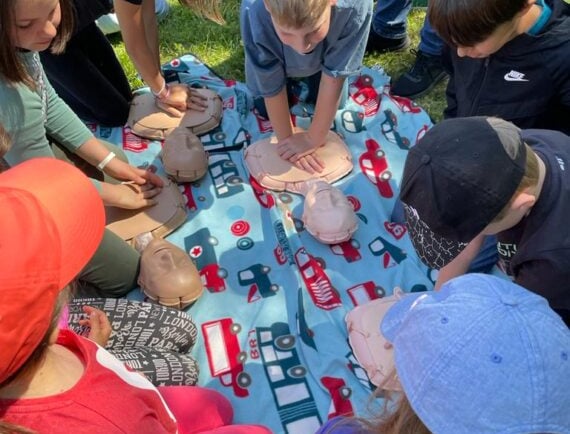
First aid skills are incredibly valuable, so as many people as possible, including children, should acquire them. Training for the youngest is based on the principle of learning through play, which yields fantastic results – children who know exactly how to save lives.
What do children learn in a first aid course?
The scope of knowledge imparted and the level of advancement always depends on the age of the children. They have an uncanny ability to learn, which can be used to teach them how to stay safe and respond to crisis situations. Preschool-aged children learn what happens to their bodies when injured and how paramedics and doctors can help them. This helps them overcome their fear of the unknown. Older children learn basic life-saving procedures, consistent with the latest guidelines from the European Resuscitation Council. They learn the procedures to follow in the event of burns, fainting, choking, fractures, or sudden cardiac arrest. They practice CPR, with particular emphasis on proper chest compression technique, using an AED, and placing the victim in the recovery position.
In addition to theory and invaluable practice, children learn how to properly call for help by calling one of two emergency numbers. Young students memorize each number and learn what information to provide during a call to the dispatcher – name, age, location of the incident, and the injured person's condition. To master this skill, the course involves role-playing scenarios that perfectly prepare children to respond appropriately without fear of doing something wrong.
Safety rules are equally important for children to learn during the course. Instructors emphasize the importance of ensuring their own safety and that of the injured person while providing aid, and of not exposing anyone to any risk. Examples are presented of potential hazards (e.g., shattered glass or traffic) and situations requiring non-standard measures (e.g., a bloody injured person's skin). Children also learn about emergency medical procedures and how to work with them. They learn about the various stages of the process, how long they take, and the order in which they are performed. This allows children to understand exactly what is happening at each stage, how paramedics work, and how they ensure their own safety during a rescue operation.
What is the course like?
The pediatric first aid course, similar to the adult training, consists of theoretical and practical components. The theory is tailored to the children's understanding and presented in an engaging and accessible manner. Practical sessions are the most important part of the course, so instructors devote significant time and energy to preparing them. Learning through play is the most effective way to learn, making first aid exercises for children fun and engaging. Young participants use professional equipment, such as manikins and AEDs, as well as medical accessories such as a thermal blanket, stethoscope, and gloves.
Every properly conducted pediatric first aid training course is based on a detailed script, which must be tailored to the participants. Toddlers are a demanding group, so instructors must be willing to improvise and be able to respond when children become overly excitable or bored. It's crucial to maintain the interest and focus of the entire group until the very last minute of the session. Furthermore, it's crucial to find a way to engage each participant and dedicate time to individual instruction and exercises.
Benefits
The most important benefit a child gains from the course is first aid knowledge and practical skills. Thanks to these, children can make a real difference in saving someone's life. This, in turn, improves the safety of all of us. Regardless of who the injured person is (a mother who fainted, a friend who injured herself on the playground, a cyclist hit right outside school), a child can help, and sometimes even make a difference, in the success of the rescue.
Additionally, familiarity with all procedures and activities boosts children's self-confidence and eliminates their fear of action. This is an extremely valuable benefit of participating in a first aid course. Through play, young students also learn to control their emotions and communicate effectively in stressful situations.
Moreover, participating in the course sensitizes children to the suffering of others, increases their empathy, and awakens their awareness of functioning in a society that collectively cares for its safety. It's one of the first lessons in collective responsibility and caring for others, whether they are a loved one or a complete stranger.
First aid training should begin as early as possible, so that it can be reinforced and supplemented with new (current) elements in subsequent years. There's no doubt that children can provide help effectively and safely, even if this means performing CPR. It's great fun for them, added value for all of us, and a huge benefit for us as a community. It's absolutely worth it!

Contact
Fundacja Z Mojego Łowiska
KRS: 0000924275
NIP: 8943173830
REGON: 520090271
Traditional transfer:
Santander Bank Polska SA
Account number: 43 1090 2457 0000 0001 4892 7592
PAGES
CONTACT DETAILS
Location: 54-620 Wroclaw, Jurija Gagarina Street 92/2
Mail: kontakt@zmojegolowiska.info
Phone: 792 800 701
© 2026 Fundacja Z Mojego Łowiska since 2021.