PROJECT OF THE EDUCATIONAL PARK AND WILD ANIMALS TREATMENT AND REHABILITATION CENTER (OLiRDZ)
Starting point – the genesis of the project
In Poland, there are dozens of centers dedicated to helping wild birds and wildlife that, for various reasons, require human support. These include the centers in Czempiń at the Polish Hunting Association Research Station, the Forestry Technical School in Warcino, and the Warsaw Zoo. The growing number of communication routes in Lower Silesia and the rapid urbanization of the suburbs of Wrocław and other large cities in our region are contributing to a growing number of traffic accidents involving birds and wild animals. Wild birds are confused by light reflections on the large glass surfaces of tall buildings or collide when flying near wind farms. As a result, the birds require professional medical and veterinary care and rehabilitation to return them to their natural habitat.
This situation, as well as societal expectations in this regard, raises the need to establish a professional center for the treatment and rehabilitation of wild animals , a need that the FOUNDATION FROM MY ŁOWISKA intends to address by planning to open such a center in the Barycz Valley. The location of this facility perfectly aligns with the zoohygienic and welfare requirements that must be met for treated animals. Veterinarian Piotr Szymański , who is responsible for establishing a similar center at the Wrocław University of Environmental and Life Sciences, is located in Złotówek, within the Oleśnica Śląska Forest District.
The center planned by the FOUNDATION FROM MY HUNTING ROOM will be an important element of environmental education, aimed at schoolchildren and students of biology, veterinary medicine, and animal husbandry. It could also serve as a meeting place and a platform for hunters, farmers, and foresters to exchange experiences in nature conservation, agricultural landscape management, animal species protection, and sustainable hunting management.
Who are we?
The FOUNDATION FROM MY HUNTING is, above all, a group of people who exceptionally value nature and the opportunity to commune with it. On September 29, 2021, we received an entry in the National Court Register (KRS) and began our work. From that moment on, we were officially able to operate, focusing on health protection and promotion, ecology and animal protection, and protection of the natural environment, natural and national heritage, as well as first aid, including the use of an AED. We are people who want to do something good, to show that it's worth doing because it benefits everyone. Simply put, we care. Although the Foundation doesn't have a long history, we have managed to implement several ideas, most notably a series of innovative workshops for children called "Little Rescuer - Little Naturalist." These are outdoor nature lessons, which we combine with falconry demonstrations and first aid training. The program is also supplemented with off-road ambulance demonstrations and automotive elements. At the end of February 2022, we became involved in activities aimed at providing aid to Ukraine. We have also started work on a new project aimed at installing and hanging 120 nesting boxes for birds of various species.
Our latest initiative focuses on beekeeping and wild beekeeping – we initiated the revival of Polish wild beekeeping by organizing the first wild beekeeping workshops in Lower Silesia, thus promoting the conservation of wild bees.
Our latest initiative focuses on beekeeping and wild beekeeping – we initiated the revival of Polish wild beekeeping by organizing the first wild beekeeping workshops in Lower Silesia, thus promoting the conservation of wild bees.
About the educational park
The assistance we are requesting aims to create one of the most beautiful places in Lower Silesia, which will serve the entire community in the fields of environmental and medical education. This location will be the starting point for dozens, even hundreds, of meetings and projects implemented by the FOUNDATION FROM MY ŁOWISKA (FISHING FOUNDATION). We also want it to serve the local community, associations, foundations, school youth, and many others in implementing their plans, projects, and statutory goals. The educational park is intended to become a symbol of caring for nature and the natural environment.
The park's offerings will be educational, and we will target children and school youth, families, and individuals. It will be located far from buildings, roads, and factories, directly bordering state forests. We want it to be unique in its educational and visual aspects, similar to our other programs.
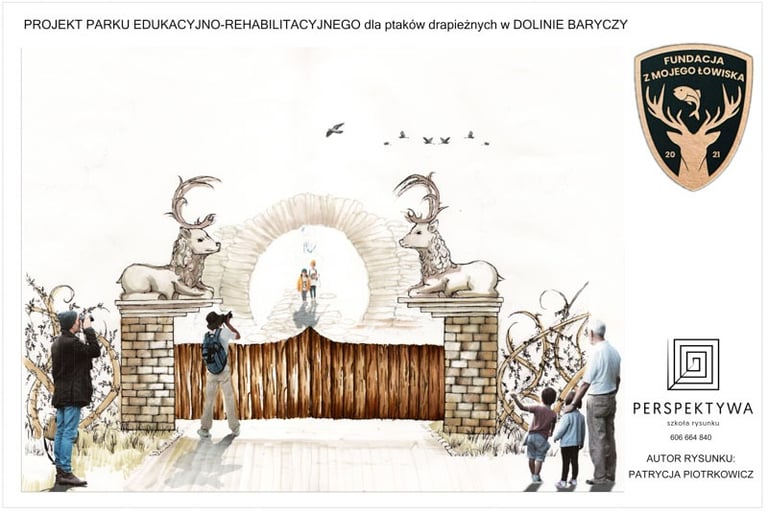
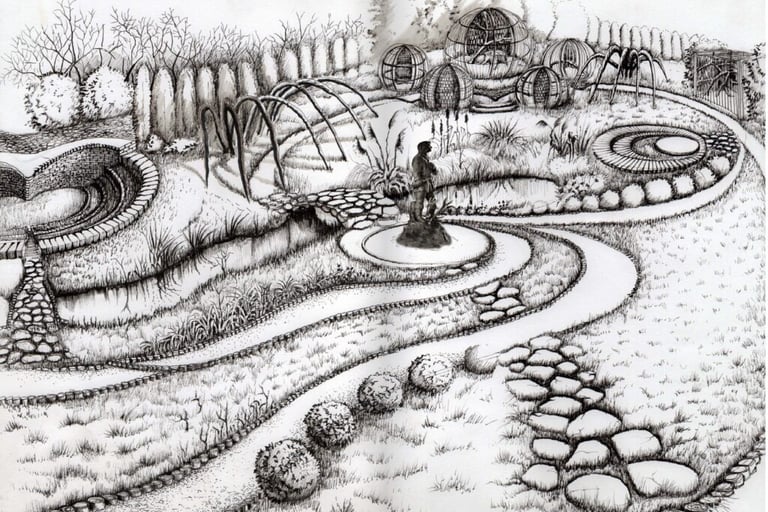
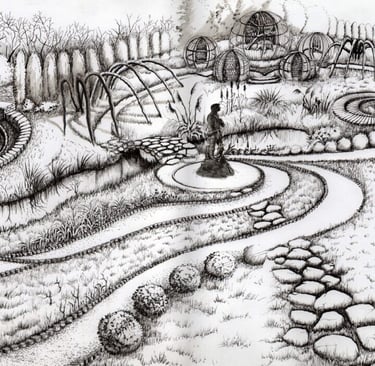
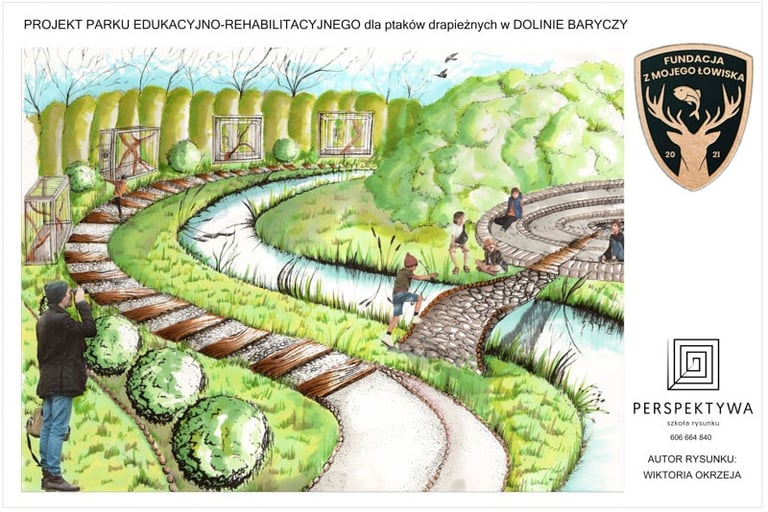
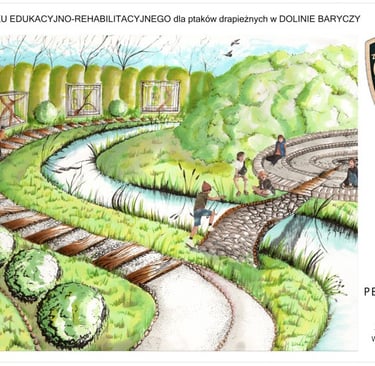
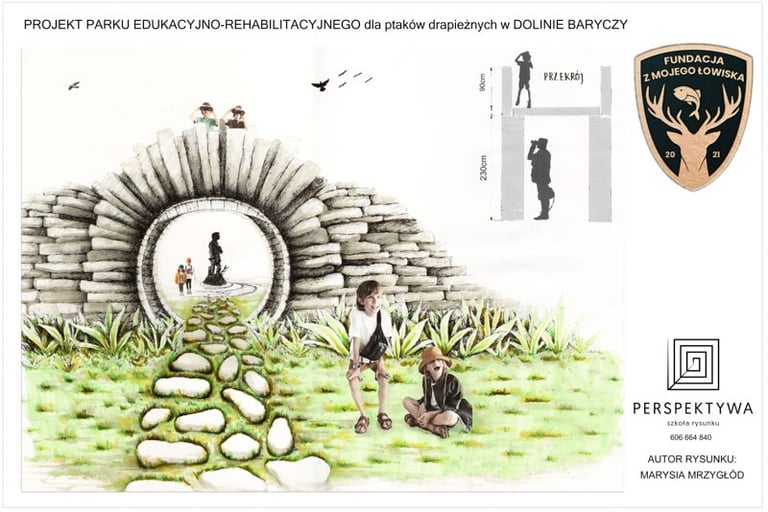
A beautiful stone entrance gate, paths reflecting natural conditions, without concrete or asphalt, resembling part of the natural environment. Paths feature information boards, aviaries with wild animals, stone walkways, native plant species, and coves with stone or wooden benches and tables. There are no visible curbs, but instead boulders and stones of various sizes, covered with moss and natural rock formations.
The boards will contain basic information about the plants and animals living in the park. Each board will have a unique QR code that, when scanned, will take the user to a website with an article on the topic and a photo gallery.
The animal enclosures will be located along the nature trails and will be designed individually for each animal species inhabiting the park. Dense vegetation, stone walkways, and tunnels made of plants such as roses, vines, and climbers will allow the park to change with the seasons.
A beekeeping open-air museum, inspired by tradition, featuring elements such as beehive logs, beehives, and information boards. The open-air museum will be both demonstrative and educational.
A large enclosure with animals such as red deer, fallow deer, and mouflon will also serve as a demonstration, educational, and rehabilitation facility. Information boards with QR codes will be placed around the enclosure. Various species of deciduous and coniferous trees will be planted within the enclosure itself, and a feeding rack and salt licks will be constructed.
The park design will also include 4 key elements:
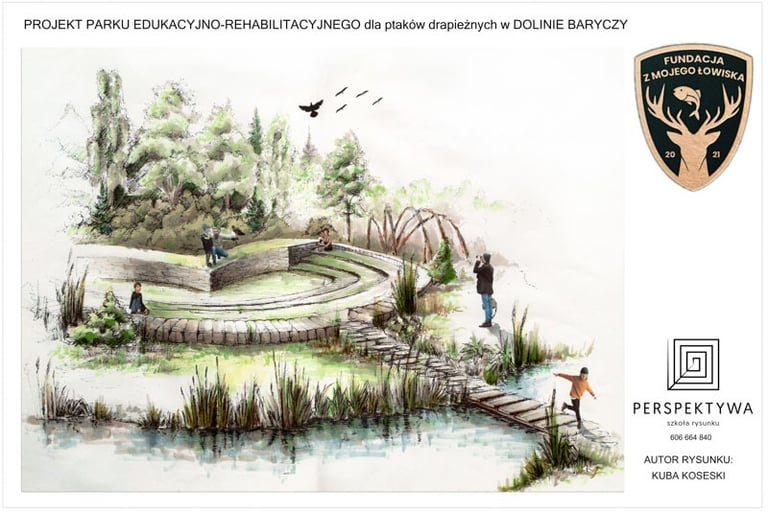
1. A designated circular area will house five large aviaries for birds of prey (eagles, hawks). The first aviary will be 10 meters in diameter and 5 meters high. This large size will allow it to serve two functions:
rehabilitation – dispersal of birds and preparation for release into the wild,
demonstration and educational, where classes and workshops will be conducted.
The remaining four aviaries will serve as permanent housing for our residents . A small grandstand will also be built here , accommodating approximately 50 participants in our workshops and demonstrations.
2. An educational shelter equipped with tables and chairs will be built on a free, undeveloped, flat area with a well-maintained lawn. A stone fire pit will also be constructed here , with a large metal grill serving as an adjustable grill. Tables and wooden stumps will be placed around the fire pit as benches. The space will be designed to accommodate cultural events held by schools, associations, foundations, and informal groups.
3. The Falconry is a wonderful place, reached by an educational trail. After crossing a stone passage, you'll find yourself in a circle flanked by six aviaries with peregrine falcons, and in the center, a sculpture of St. Hubert.
4. The Owl House will be built on a separate section of one of the educational trails. Ten aviaries for various owl species will be built, and all will be enhanced with information boards.
The park will also have aviaries for pheasants, partridges, peacocks and many other species.
The goals and tasks of the Center in the field of rehabilitation
During Piotr Szymański's several years of veterinary practice in the treatment and rehabilitation of wild birds, each year, from several to several dozen individuals of various species have required assistance (from eagles – white-tailed eagles, hawks, buzzards, sparrowhawks, and kestrels, to owls – tawny owls, barn owls, and storks, swans, wild ducks, starlings, wild geese, and woodpeckers). Other wild animals also require assistance, as a result of various accidents and require veterinary care and rehabilitation.
MAIN TASK
treatment and rehabilitation of wild birds and animals showing symptoms of disease or being victims of accidents
The center would be a place where people, increasingly sensitive to the plight of animals, could entrust their found birds to professional care, especially since such specialized centers are rare. Its location would create ideal conditions for the treatment and rehabilitation of wild animals away from urban areas. After treatment and rehabilitation, the animals would be released back into the wild.
Collaboration with the Faculty of Veterinary Medicine at the Wrocław University of Environmental and Life Sciences and the University's Forest Environment and Animal Breeding Research Center will enable comprehensive diagnostics of animal diseases and the substantive use of the faculty's equipment. This will allow the Center to be run professionally.
The center will also serve an educational purpose, promoting the protection of wild animals among the public. This, however, does not preclude the establishment of a professionally equipped veterinary clinic at the Z MOJEGO ŁOWISKA FOUNDATION Center. The sociological aspect is to sensitize people to the plight of animals, raise awareness of the role of wild animals in ecosystems, and the interdependencies between species within them. We are open to collaboration with Agricultural Advisory Centers, the Polish Hunting Association, the Polish Society for the Protection of Birds, the Eagle Protection Committee, the State Forests, and other organizations involved in wildlife conservation. We believe we have an important role to play in this regard.
Additionally, the Center could conduct research aimed at protecting very rare bird species that, despite current efforts to rebuild their populations, are still threatened with extinction (breeding and reintroduction of the peregrine falcon – Falco perregrinus). In this regard, we will rely on the experience of Mr. Piotr Szymański, who co-initiated the Peregrine Falcon Reintroduction Program in Lower Silesia (Milicz Forest District) and is a veterinary supervisor for capercaillies in the Lower Silesian Forests, and is intimately familiar with the realities of such projects. Research on birds of prey could be undertaken in collaboration with ornithological research institutions. In addition to the activities described above, the Center could provide medical and veterinary services for the treatment of diseases in game birds kept by falconers.
The infrastructure and logistics facilities of the Center
A facility such as the Wild Animal Treatment and Rehabilitation Center should be located in a quiet area, away from the hustle and bustle of urban areas, which are stressful for wild animals. Its surroundings should constitute an enclave whose natural conditions resemble those of wild animals. The site where the Center would be built should include several aviaries, acting as a type of hospital. Naturally, each aviary should be adapted to the zoohygienic and welfare requirements of the individual animal species.
The conditions created for such specific patients are intended to enable rapid treatment, full rehabilitation, and a return to nature. A key premise for the operation of such a center should be the return of patients to their natural habitat, especially rare bird and mammal species. In such cases, monitoring of the released individual and tracking its fate using telemetry devices can be conducted. For these species, if the prognosis for treatment and rehabilitation is poor, further breeding can be attempted. This is important for rare species of birds of prey and forest gallinaceous, which are becoming increasingly scarce in Lower Silesia, particularly the capercaillie, whose last remaining habitats are recorded in the Karkonosze Mountains and the Lower Silesian Forests.
The Center's space will allow for the construction of 10-14 bird aviaries and 3-5 enclosures for wild animals. These facilities can accommodate approximately 30 wild birds and 10-15 game animals. In accordance with zoohygiene standards, designated areas should be used for storing feed for granivorous birds, and refrigeration and freezing for meat for birds of prey, storks, and herons. The space requirements for individual bird species are listed. Aviaries for wild birds can be divided into several categories, depending on the bird species and their biology.
Animals that show no hope for recovery or rehabilitation will be euthanized. Those that die naturally will be transferred to the Department of Pathology, Faculty of Veterinary Medicine, Wrocław University of Environmental and Life Sciences, for educational purposes.
It's important that as many patients as possible leave the Center fully recovered and able to live normally in the wild. Statistical data from similar centers, as well as our own veterinary practice, indicate that this percentage ranges between 50 and 60%. This is particularly important for rare species. The Center will also house birds of prey used for falconry purposes.

Contact
Fundacja Z Mojego Łowiska
KRS: 0000924275
NIP: 8943173830
REGON: 520090271
Traditional transfer:
Santander Bank Polska SA
Account number: 43 1090 2457 0000 0001 4892 7592
PAGES
CONTACT DETAILS
Location: 54-620 Wroclaw, Jurija Gagarina Street 92/2
Mail: kontakt@zmojegolowiska.info
Phone: 792 800 701
© 2026 Fundacja Z Mojego Łowiska since 2021.